
I’ve passed the Kubernetes and Cloud Native Security Associate (KCSA) exam.
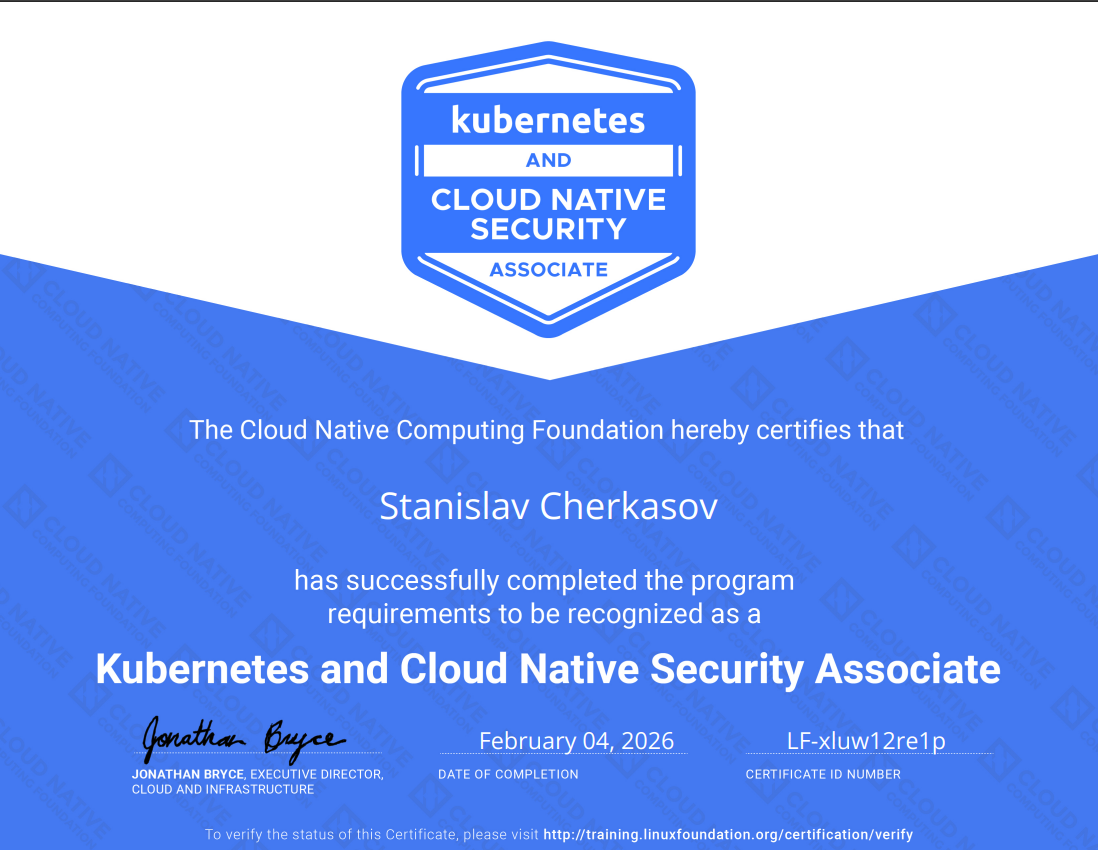
The exam is online, proctored, multiple-choice (60 questions / 90 minutes). The certification is valid for 2 years.
Domains#
The KCSA blueprint is split into six domains. Here is the weight distribution:
%%{init: {"theme":"base","themeVariables":{"pie1":"#ff6b6b","pie2":"#feca57","pie3":"#48dbfb","pie4":"#1dd1a1","pie5":"#5f27cd","pie6":"#576574"}}}%%
pie showData
  title KCSA domains (weights)
  "Overview of Cloud Native Security" : 14
  "Kubernetes Cluster Component Security" : 22
  "Kubernetes Security Fundamentals" : 22
  "Kubernetes Threat Model" : 16
  "Platform Security" : 16
  "Compliance and Security Frameworks" : 10
A quick breakdown of what typically sits inside each bucket:
Overview of Cloud Native Security (14%)
- The “4Cs” model (Cloud, Cluster, Container, Code)
- Shared responsibility and common controls
Kubernetes Cluster Component Security (22%)
- Control plane + etcd basics (what to protect and why)
- Node components (kubelet, runtime) and cluster networking
Kubernetes Security Fundamentals (22%)
- AuthN/AuthZ and RBAC fundamentals
- Pod Security Standards / Pod Security Admission, NetworkPolicy, Secrets, audit logs
Kubernetes Threat Model (16%)
- Trust boundaries and common attack paths (privilege escalation, sensitive data access, DoS)
Platform Security (16%)
- Supply-chain basics (images, registries, signatures) and platform controls (admission, observability)
Compliance and Security Frameworks (10%)
- What compliance frameworks look like in practice (controls, evidence, automation)
Preparation#
My prep was intentionally boring:
Official exam pages
Curriculum
Kubernetes docs(not available during exam)
Hardening guidance