
I’ve passed the Certified Argo Project Associate (CAPA) exam.
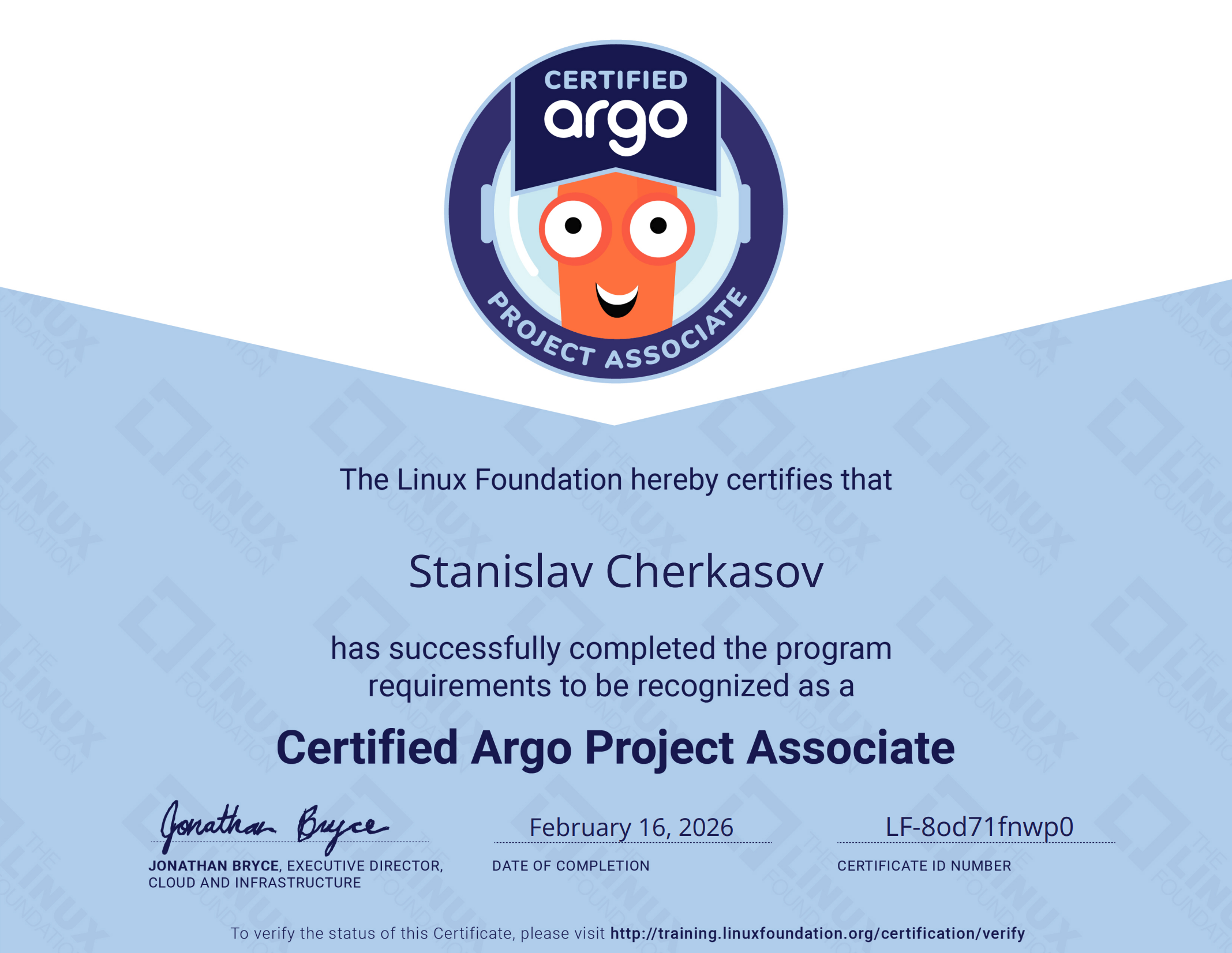
For me, CAPA felt like a logical continuation after CGOA: still cloud-native and Kubernetes-first, but now focused on the Argo Project ecosystem beyond GitOps.
If you work with Argo CD daily, you’ll get a head start - but CAPA expects you to be comfortable with the other Argo tools too: Workflows, Rollouts, and Events.
Exam format#
The exam is online, proctored, multiple-choice. The duration is 90 minutes. The certification is valid for 2 years.
Domains#
The CAPA blueprint is split into four domains with the following weights:
pie showData
  title CAPA domains (weights)
  "Argo Workflows" : 36
  "Argo CD" : 34
  "Argo Rollouts" : 18
  "Argo Events" : 12
A quick “what’s inside” breakdown (aligned with the official domains/competencies):
Argo Workflows (36%)
- Workflow fundamentals
- Templates and the workflow spec
- Generating and consuming artifacts
- Working with DAGs (Directed Acyclic Graphs)
- Data processing jobs with Argo Workflows
Argo CD (34%)
- Fundamentals and application synchronization
- Using the
Applicationresource - Helm and Kustomize configuration
- Common reconciliation patterns
Argo Rollouts (18%)
- Fundamentals
- Common progressive rollout strategies
AnalysisTemplateandAnalysisRunconcepts
Argo Events (12%)
- Fundamentals
- Components and architecture
Preparation#
My prep stack was simple:
- Official Argo docs (whenever I needed to double-check behavior and concepts)
- KodeKloud (structured coverage + hands-on labs)
The surprising part: Argo Workflows (and DAGs)#
I expected Argo CD to be the “main character” for me - and it helped a lot - but the real discovery was Argo Workflows.
I had heard about DAG-based workflow engines before, and I even worked with similar ideas in another product, but I never used Argo Workflows seriously. In the KodeKloud course, the DAG model (dependencies, parallelism, fan-out / fan-in) is explained really well, and that made the whole topic click for me.
Now I’m genuinely interested in using Argo Workflows beyond exam prep - it’s one of those tools that becomes surprisingly powerful once you start thinking in DAGs.
Bonus: promos happening right now#
- KodeKloud: Free Learning Week (unlimited access to Standard courses + labs) runs February 10-17, 2026