
🇵🇱 Polski#
English version below.
Krótko na początku#
To nie będzie kolejny przewodnik po zapisach, dokumentach i organizacji egzaminu. O tym pisałem już przy B1: Państwowy egzamin B1.
Organizacyjnie wszystko było bardzo podobne: zapisy, dokumenty, część pisemna, część ustna, depozyt elektroniki i cała logistyka egzaminu. Nie ma sensu rysować tego samego schematu drugi raz.
Tutaj chcę zapisać tylko moje osobiste wrażenia po B2: czym ten egzamin różnił się dla mnie od B1, co zapamiętałem najbardziej i jakie dostałem wyniki.
Mały disclaimer: to jest mój prywatny opis i moje osobiste odczucia. Nie są to oficjalne wytyczne ani porady egzaminacyjne.
Moje wrażenia po B2#
Po B1 miałem poczucie, że egzamin w dużej mierze sprawdza znajomość formatu. Przy B2 format nadal jest ważny, ale sam język zaczyna mieć większe znaczenie.
Teksty są dłuższe. Niektóre zadania ze słuchania wydawały mi się trudniejsze. W pisaniu trzeba napisać więcej i nie chodzi już tylko o poprawne zdania, ale też o logiczny, spójny tekst z sensowną argumentacją. Część zadań miała też trochę inny format, więc nie było to po prostu “B1, tylko z większą liczbą słów”.
Jednocześnie różnica nie była dla mnie szokująca. Bardziej miałem wrażenie, że to ten sam świat, tylko poziom wyżej: więcej tekstu, więcej myślenia, mniej miejsca na pisanie “jakoś to będzie”.
Sztuczna inteligencja na egzaminie#
Najbardziej zapamiętałem część pisemną. Trafił mi się temat o sztucznej inteligencji. Była ilustracja: człowiek i robot siłują się na rękę.
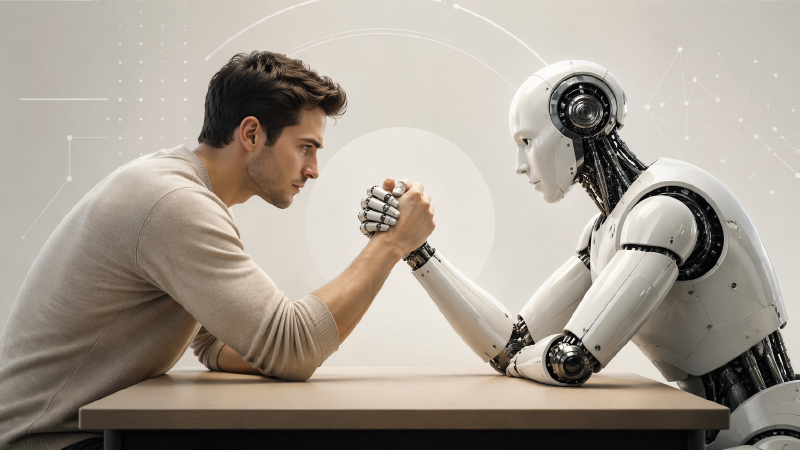
To był bardzo aktualny temat i chyba właśnie dlatego tak mi się spodobał. Na egzaminie językowym można dostać coś zupełnie neutralnego, a tutaj pojawił się temat, o którym naprawdę jest co powiedzieć.
W takich tematach łatwo pójść w prostą stronę: AI jest dobre albo AI jest złe. Ja nie chciałem zajmować jednej skrajnej strony. Opisałem to raczej jako walkę i jedność przeciwieństw.
Z jednej strony AI może odbierać część pracy, zmieniać rynek i tworzyć presję na ludzi. Z drugiej strony daje ogromne możliwości: automatyzuje nudne zadania, pomaga szybciej pracować, szybciej się uczyć i robić rzeczy, które wcześniej były poza zasięgiem.
I to jest właśnie najciekawsze: ta sprzeczność nie znika. Nie da się jej łatwo rozwiązać jednym zdaniem. Dlatego spróbowałem pokazać problem z obu stron i zostawić pytanie częściowo otwarte.
W pewnym momencie naprawdę obudził się we mnie talent pisarski. Napisałem po polsku całkiem długi tekst i miałem poczucie, że to nie jest tylko “zadanie egzaminacyjne”, ale mała opinia albo miniartykuł. I to było bardzo przyjemne uczucie: na egzaminie językowym pisać o czymś, o czym faktycznie mam coś do powiedzenia.
Podsumowanie#
B2 odebrałem jako dużo bardziej dojrzały egzamin. Nie tylko “czy znasz polski”, ale też “czy umiesz używać polskiego do myślenia, argumentowania i normalnej komunikacji”.
Cieszę się, że zdałem. Wynik nie jest idealny, ale dla mnie jest ważny: to kolejny formalny krok, a przede wszystkim potwierdzenie, że polski coraz bardziej staje się dla mnie językiem pracy, życia i realnego myślenia.
Wyniki#
Poziom egzaminu: B2
Czy egzamin zdany? TAK
Wyniki w procentach:
- rozumienie ze słuchu:        79%
- rozumienie tekstów pisanych: 71%
- pisanie:                     76%
- poprawność gramatyczna:      64%
- mówienie:                    89%
ŚREDNIA Z EGZAMINU:            76%
🇬🇧 English#
Briefly at the beginning#
This is not going to be another guide about registration, documents and exam organization. I already wrote about that after my B1 exam: Państwowy egzamin B1.
Organizationally, everything was very similar: registration, documents, the written part, the speaking part, electronics deposit and the general exam logistics. There is no point in drawing the same scheme for the second time.
Here I only want to write down my personal impressions after B2: how this exam felt different from B1, what I remember the most, and what results I received.
Small disclaimer: this is my private description and my personal experience. These are not official guidelines or exam preparation advice.
My impressions after B2#
After B1, I had the feeling that the exam checked the knowledge of the format to a large extent. At B2, the format is still important, but the language itself starts to matter more.
The texts are longer. Some listening tasks felt more difficult to me. In writing, you need to write more, and it is no longer only about correct sentences, but also about a logical, coherent text with reasonable argumentation. Some tasks also had a slightly different format, so it was not simply “B1, but with more words”.
At the same time, the difference was not shocking for me. I rather felt that it was the same world, just one level higher: more text, more thinking, and less space for writing “somehow it will work”.
Artificial intelligence at the exam#
The writing part is what I remember the most. I got a topic about artificial intelligence. There was an illustration: a human and a robot arm wrestling.
That was a very current topic, and I think that is exactly why I liked it so much. During a language exam, you can get something completely neutral, but here the topic was something I actually had something to say about.
With such topics, it is easy to take a simple position: AI is good or AI is bad. I did not want to take one extreme side. I described it more as a struggle and unity of opposites.
On the one hand, AI can take away some jobs, change the market and create pressure on people. On the other hand, it gives enormous opportunities: it automates boring tasks, helps people work faster, learn faster and do things that were previously out of reach.
And this is exactly the most interesting part: this contradiction does not disappear. It cannot be easily solved in one sentence. That is why I tried to show the problem from both sides and leave the question partly open.
At some point, a writing talent really woke up in me. I wrote quite a long text in Polish, and I had the feeling that it was not just an “exam task”, but a small opinion piece or mini-article. And that was a very pleasant feeling: during a language exam, to write about something I actually had something to say about.
Summary#
I perceived B2 as a much more mature exam. It is not only “do you know Polish”, but also “can you use Polish for thinking, arguing and normal communication”.
I am happy that I passed. The result is not perfect, but it is important to me: it is another formal step, and above all a confirmation that Polish is becoming more and more a language of work, life and real thinking for me.
Results#
Exam level: B2
Exam passed? YES
Results in percentages:
- listening comprehension:     79%
- reading comprehension:       71%
- writing:                     76%
- grammatical correctness:     64%
- speaking:                    89%
AVERAGE EXAM SCORE:            76%